Degradation, EOL and augmentation
The battery's SOH curve, end-of-life by years or cycles, replacement vs augmentation, and how it differs from generation degradation.
A battery's usable energy shrinks over the life of a project in two ways that are easy to conflate: the pack's own health declines year on year, and — for a generation-backed project — the solar or wind feeding it declines too, for an entirely different reason. This page covers the battery side: its state-of-health (SOH) curve, the two ways to define when it reaches end-of-life (EOL), and what happens to the plant once it does.
SOH degradation curves
State of health (SOH) — the battery's remaining capacity relative to nameplate as it ages — follows one of two curves, chosen on the 🔋 BESS tab. Linear (Year-1 + Annual), the default, applies one fixed loss in Year 1 and a separate fixed annual loss every year after — two independent fields, each with its own range. Custom Year-by-Year replaces that with a table you fill in yourself, one SOH value per project year — useful for a curve that doesn't follow a straight line, such as a manufacturer's own warranty curve. Switching to Custom starts from the values the Linear formula would have produced; a ↺ Fill from Linear button re-applies that starting point at any time.
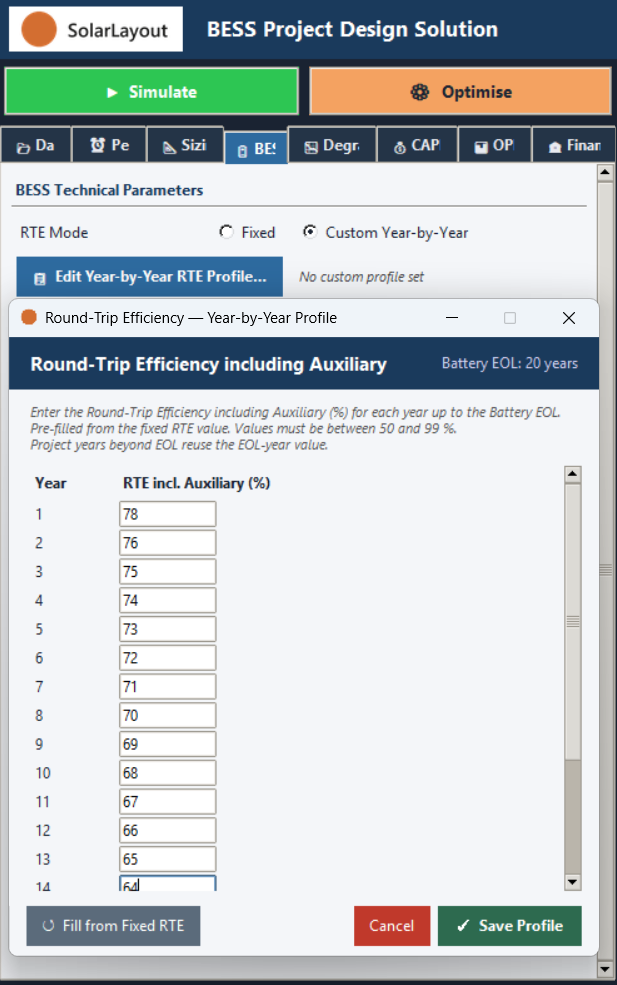
Whichever curve is active, SOH is one of the two factors — alongside depth of discharge — that scale nameplate energy down to what the dispatch model can actually draw on. See The battery model for how the two combine.
End-of-life: years or cycles
Battery EOL — end-of-life, the point at which the pack is considered exhausted and is replaced or augmented — is defined one of two ways, chosen on the same tab:
- In Years (the default): EOL is simply the pack's age, in years.
- In Total Cycles: EOL is set by cumulative usage instead, measured in EFC — Equivalent Full Cycle, one full nameplate-energy charge/discharge equivalent. Annual EFC throughput is worked out as that year's discharge energy divided by the pack's rated usable energy, and accumulated year on year against a Rated Cycle Life target, expressed in cycles, to find the year EOL is reached. A separate End-of-Warranty SOH @ N field records the SOH the pack is warrantied to still have at that rated cycle count.
Choosing the cycles basis also changes how the plant is dispatched day to day — see Cycle-mode in How dispatch works.
Replacement vs augmentation
Reaching EOL triggers one of two strategies, also chosen on the 🔋 BESS tab:
- Replacement (full swap), the default: the whole pack is swapped out in the EOL year.
- Augmentation (top-up): instead of a full swap, additional MWh tranches are added to the existing pack. Automatic (restore to nameplate) tops it back up to nameplate every EOL-interval year; Manual opens a schedule you fill in yourself, one row per tranche giving the year and the capacity to add. Either way, each new tranche degrades from its own install year rather than from commissioning, and books its own capital cost in the year it's added, separate from the original build.
See Battery parameters for the SOH degradation, Battery EOL and EOL Strategy fields together, with their defaults and ranges.
The declining cost of a later tranche
A tranche added years into a project doesn't have to cost the same, per MWh, as the pack installed on day one. BESS Cost Decline (augment.), on the 🏦 Finance tab, applies an annual decline to the BESS unit cost used specifically for augmentation tranches, so a tranche added later in the project life can be costed lower than the figure entered on the 💰 CAPEX tab for the original build, if you set a decline rate. See Financing and discounting.
Not the same as generation degradation
The 📉 Degrad. tab sets a separate figure entirely: how much the Solar or Wind generation feeding the plant declines over the project life, following the same Year-1-plus-annual shape but applied to generation rather than to the battery. The two are tracked, and set, independently. See Generation degradation.
Where to go next
The battery model
Usable energy, round-trip efficiency, C-rate and state of charge
How dispatch works
The dispatch rule that applies once Battery EOL is set to cycles
Battery parameters
Every RTE, DoD, SOH, EOL and augmentation field
Financing and discounting
BESS Cost Decline and the rest of the financial assumptions